
IoT devices use a wide range of frequency bands below 6 GHz, from Sub-GHz LPWAN sensors to 5G and Wi-Fi systems. Lower frequencies such as 433 MHz, 868 MHz, 915 MHz and low-band cellular usually provide longer range and better penetration, while higher frequencies such as 2.4 GHz, 5 GHz and 6 GHz support higher data rates over shorter distances. The right choice depends on range, data rate, power budget, deployment region and antenna design. This guide explains the main IoT frequency bands below 6 GHz and how to select the correct modem, router or antenna type.
Quick answer
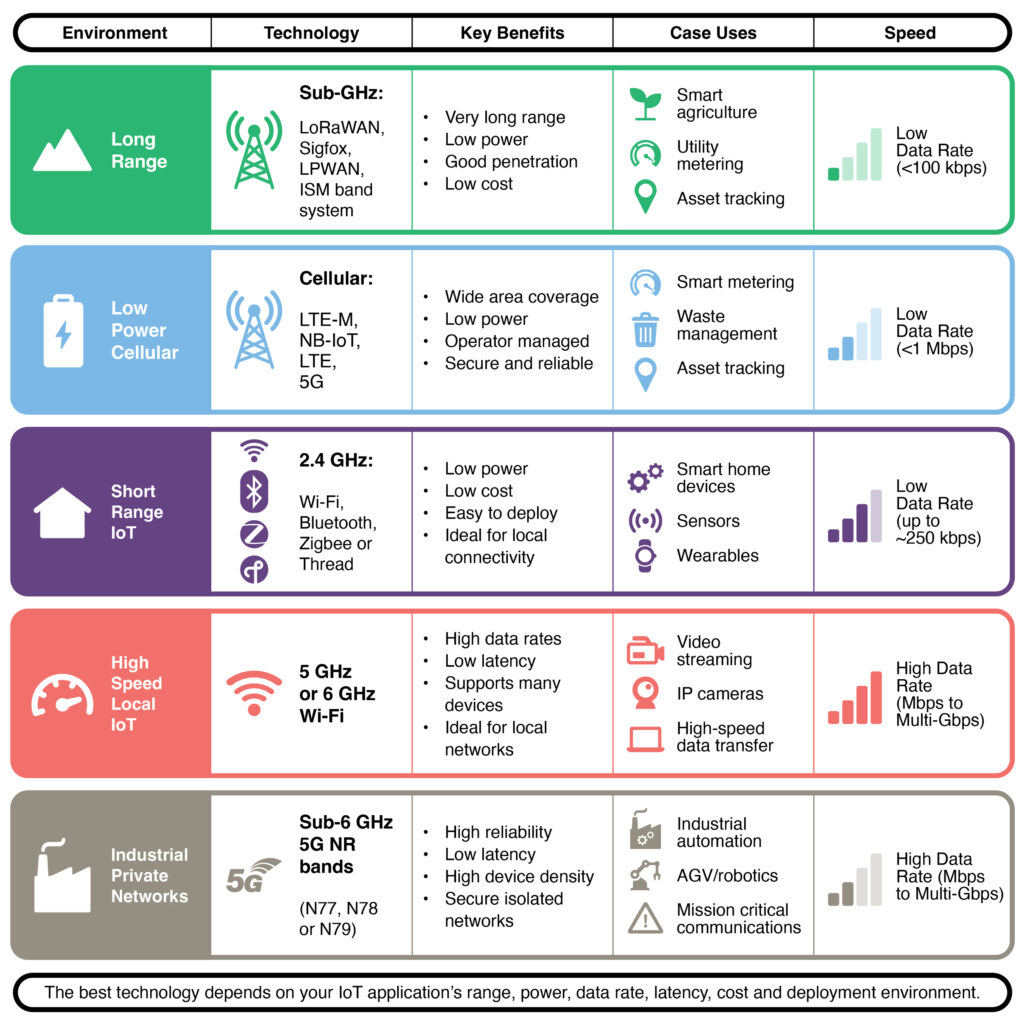
Best for long range: Sub-GHz LPWAN such as 433 MHz, 868 MHz or 915 MHz
Best for low-power cellular: LTE-M or NB-IoT
Best for short-range IoT: 2.4 GHz Wi-Fi, Bluetooth, Zigbee or Thread
Best for high-speed local IoT: 5 GHz or 6 GHz Wi-Fi
Best for industrial private networks: Sub-6 GHz 5G NR bands such as n77, n78 or n79
Common mistake: Selecting the radio module before checking regional bands, antenna size and enclosure constraints
Why frequency band choice matters
Frequency affects how an IoT device performs in the field. Lower-frequency systems generally travel further and penetrate walls, cabinets and equipment better, but they usually carry less data. Higher-frequency systems can support faster connections and denser networks, but range is shorter and antenna placement becomes more critical.
The frequency band also affects the physical design. A Sub-GHz antenna is normally larger than a 2.4 GHz antenna. A wideband cellular antenna must cover multiple LTE or 5G bands. A MIMO 5G router may need several antennas with enough spacing and isolation to work correctly.
For this reason, frequency selection should be treated as a system-level decision, not just a module choice.
Sub-GHz IoT: 433 MHz, 868 MHz and 915 MHz
Sub-GHz bands are widely used for long-range, low-power IoT applications. Typical technologies include LoRaWAN, Sigfox and other LPWAN or ISM-band systems.
These bands are suited to:
- smart metering
- agriculture
- environmental monitoring
- remote telemetry
- industrial sensors
The main advantage is propagation. Sub-GHz signals generally travel further than 2.4 GHz or 5 GHz signals and are less affected by obstacles. This makes them useful for outdoor sensors and devices that only send small amounts of data.
The limitation is data rate. Sub-GHz LPWAN is not intended for video, frequent firmware updates or high-throughput diagnostics. Regional availability also matters: 868 MHz is common in Europe, while 915 MHz is common in other regions, so product variants may be required.
2.4 GHz IoT: Wi-Fi, Bluetooth, Zigbee and Thread
The 2.4 GHz band is one of the most common short-range IoT bands. It supports Wi-Fi, Bluetooth, Bluetooth Low Energy, Zigbee and Thread.
It is often used in:
- smart home devices
- wearables
- consumer IoT
- building automation
- short-range industrial monitoring
The advantage is compatibility. Many phones, routers, gateways and controllers already support 2.4 GHz technologies. Antennas are also compact, which helps in small embedded products.
The main problem is congestion. Wi-Fi, Bluetooth, Zigbee and Thread may all operate in the same band, so coexistence and interference should be checked during testing. Enclosure material, PCB layout, batteries and nearby antennas can also affect practical range.
Cellular IoT: LTE-M, NB-IoT, LTE and 5G
Cellular IoT is used where devices need wide-area connectivity without relying on a local gateway. It uses licensed mobile network spectrum, and the exact bands depend on region, operator, module and SIM.
For low-power cellular sensors, LTE-M and NB-IoT are usually the first options to consider.
LTE-M / Cat-M1 is suited to devices that need low power, moderate data rates and mobility support. It is commonly used for asset tracking, metering, wearables and telemetry.
NB-IoT is suited to very low-data applications where deep indoor coverage and long operating life are more important than speed. Typical uses include static sensors, alarm panels, HVAC monitoring and utility metering.
For these applications, Siretta’s LTE-M and NB-IoT industrial modem range is designed for low-power cellular IoT deployments such as metering, asset tracking, environmental monitoring and remote sensor telemetry.
For higher-throughput applications, a full LTE router is usually more appropriate. If the system needs Ethernet, serial connectivity, VPN support or remote equipment access, a compact 4G router such as the QUARTZ-COMPACT-LTE industrial router is a better fit than a low-power modem.
Mid-band 5G for industrial IoT
Sub-6 GHz 5G NR bands, including n77, n78 and n79, are used where higher capacity, lower latency and dense device support are required. These bands are relevant to private 5G networks, robotics, machine monitoring, smart factories and industrial gateways.
The trade-off is range. Mid-band 5G provides more throughput and capacity than lower-frequency cellular systems, but it usually needs more careful coverage planning. Antenna placement and MIMO layout are also more important.
For industrial 5G routers, gateways and private network equipment, Siretta’s 5G antenna range supports common sub-6 GHz 5G and 4G applications across embedded, terminal, magnetic, through-hole, wall and pole-mounted formats.
5 GHz and 6 GHz Wi-Fi
The 5 GHz and 6 GHz bands are used by high-speed Wi-Fi systems. Wi-Fi 5 and Wi-Fi 6 commonly use 5 GHz, while Wi-Fi 6E and Wi-Fi 7 can use 6 GHz where regulations allow it.
These bands are suited to:
- smart cameras
- enterprise IoT
- video systems
- industrial tablets
- local diagnostics
- high-speed gateways
The advantage is throughput. These bands support faster data transfer and more channel capacity than 2.4 GHz. The disadvantage is reduced range and weaker penetration through walls, metalwork and enclosures.
For local high-speed IoT, 5 GHz and 6 GHz Wi-Fi are useful, but access point position and antenna placement must be validated in the final installation.
Antenna and band selection
Frequency band choice directly affects antenna selection. The antenna must support the required technology, frequency range, mounting method, IP rating and MIMO configuration.
For cellular designs, it is also important to check the exact LTE or 5G NR bands used in the deployment country. A router or antenna may support “4G” or “5G” generally, but still not cover the required regional bands.
The Siretta antenna selector tool can be used to filter antennas by mounting type, cellular technology, Wi-Fi technology, ISM technology, GNSS, IP rating and MIMO configuration.
The Siretta band selector tool can be used to narrow products by LTE bands such as B1, B3, B7 and B20, and 5G NR bands such as n77, n78 and n79.
IoT frequency band comparison
Selection checklist
Before choosing the radio hardware, confirm:
- operating country or region
- required range
- required data rate
- battery or mains power
- indoor or outdoor installation
- static or mobile device
- LTE or 5G NR bands required
- antenna mounting method
- enclosure material
- IP rating
- MIMO requirement
- cable length
Need help selecting the right IoT hardware?
If you can share the deployment region, radio technology, enclosure type, mounting method and expected cable length, Siretta can recommend a suitable modem, router or antenna configuration for evaluation.
Button text: Request recommended sample (https://www.siretta.com/request-for-quote/)
Secondary: Ask an RF engineer (https://www.siretta.com/find-out-more/)