
Introduction
SMA, Precision SMA, 3.5 mm, and 2.92 mm RF connectors look very similar externally. They all use threaded coupling, maintain a 50 Ω impedance, and some versions can mechanically mate with each other. However, their frequency performance is significantly different.
The difference in frequency capability is not determined by the external connector size, but by the internal RF geometry and precision engineering. Although these connectors share similar mechanical appearances, their internal coaxial structures are designed differently. Factors such as centre conductor diameter, outer conductor dimensions, dielectric arrangement, manufacturing tolerances, and suppression of higher-order electromagnetic modes determine the maximum operating frequency.
Higher-frequency performance is achieved through improved control of:
- Internal conductor geometry
- Dielectric structure
- Manufacturing precision
- Unwanted electromagnetic mode suppression
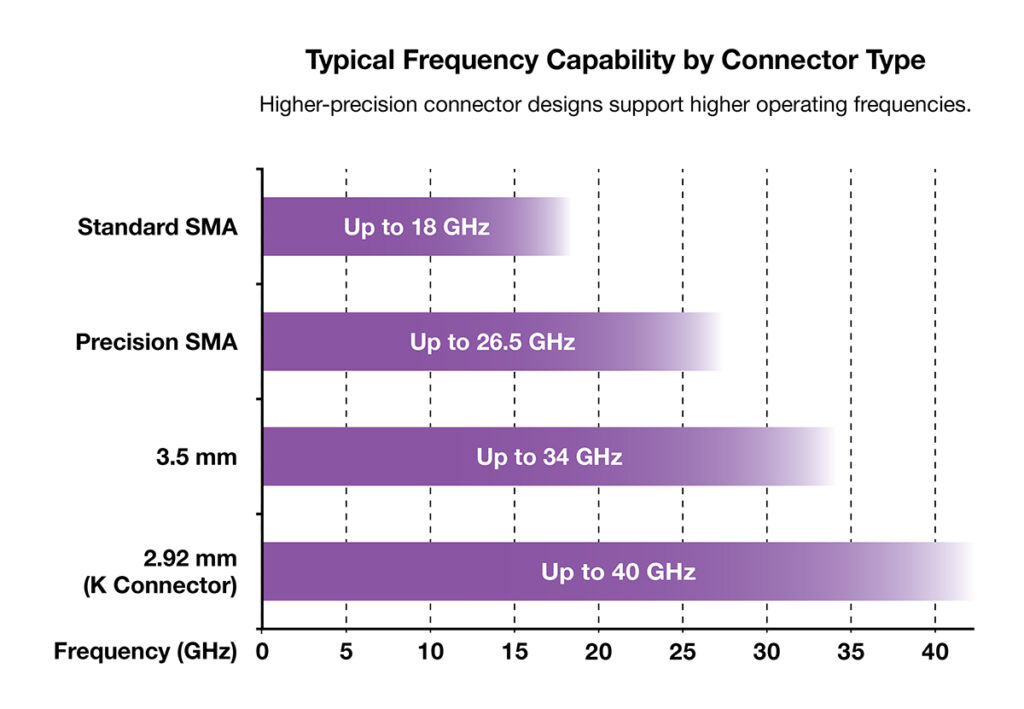
The evolution from SMA to Precision SMA, 3.5 mm, and 2.92 mm represents the continuous development of RF connector technology, moving from general-purpose RF connectivity to precision microwave and millimetre-wave applications.
RF Connector Design and Frequency Limitations
An RF connector is a miniature coaxial transmission line consisting of a centre conductor, dielectric support, and outer conductor. Its purpose is to maintain a constant 50 Ω impedance while minimising reflection and signal loss.
At higher frequencies, connector dimensions become electrically significant because wavelength becomes shorter:
| Frequency | Wavelength |
| 10 GHz | 30 mm |
| 18 GHz | 16.7 mm |
| 26.5GHz | 11.2 mm |
| 34GHz | 8.8 mm |
| 40 GHz | 7.5 mm |
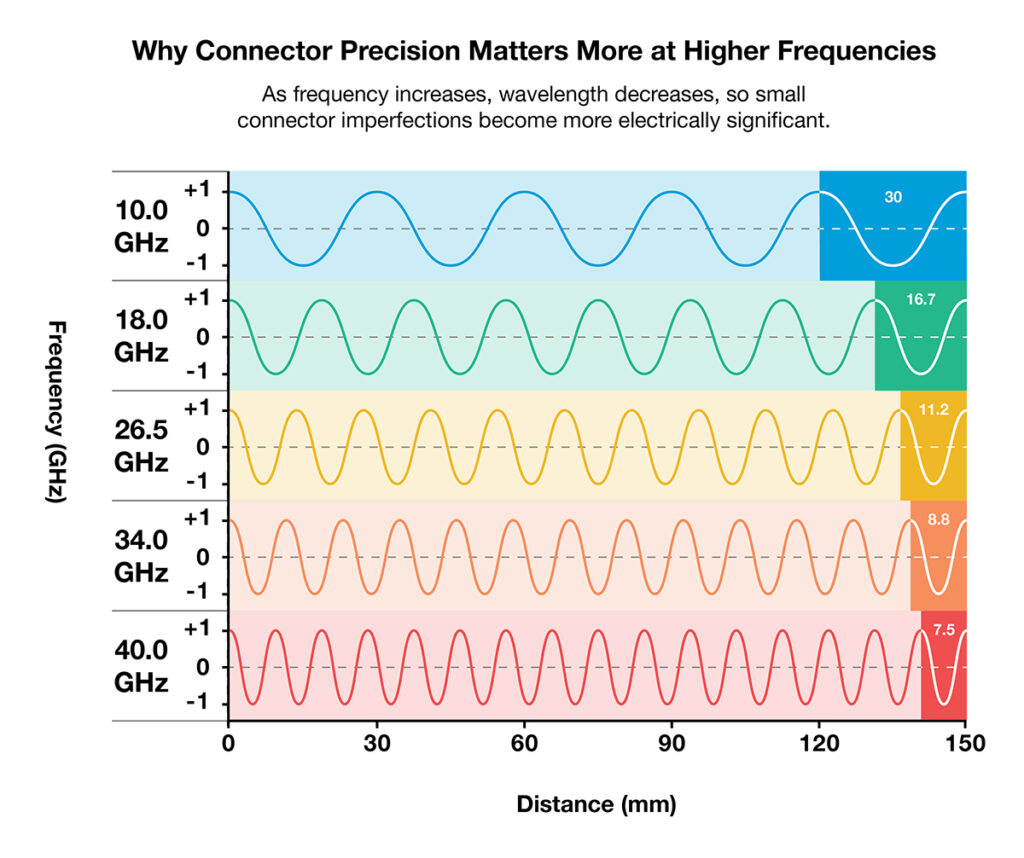
When connector dimensions become large compared with wavelength, unwanted electromagnetic modes can appear, causing increased reflection, loss, and reduced signal accuracy.
Smaller internal structures and improved precision increase the frequency range where the connector can maintain stable RF performance.
Standard SMA and Precision SMA Connectors
| Connector | Key Characteristics | Advantages | Typical Applications | Frequency Range |
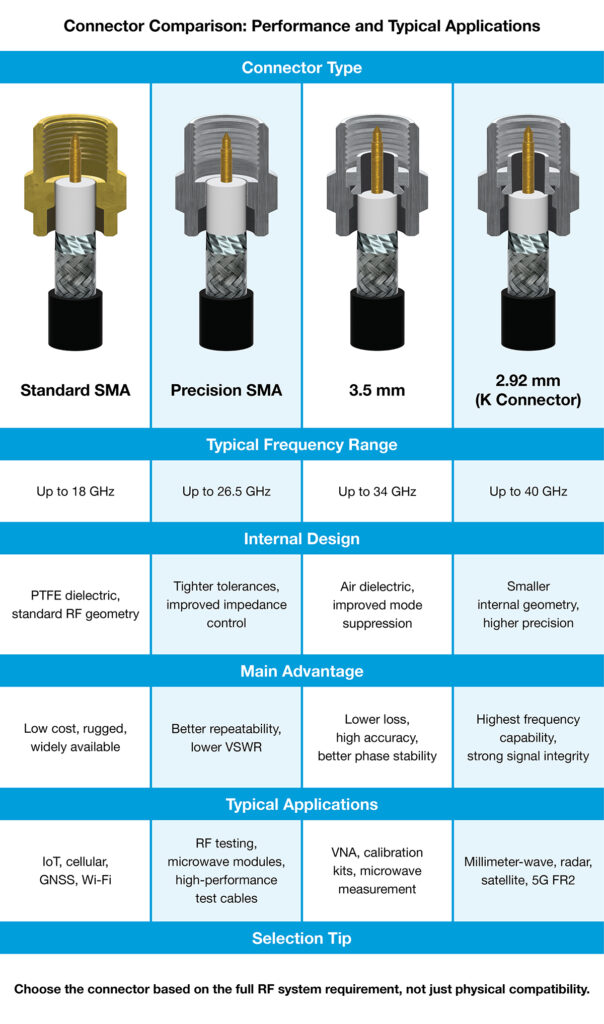
| Standard SMA | 50 Ω impedance, PTFE dielectric support, robust mechanical design, 1/4-36 threaded coupling | Low cost, reliable, widely available, good RF performance | Cellular routers, GNSS receivers, Wi-Fi equipment, Industrial IoT devices | DC–18 GHz |
| Precision SMA | Improved RF geometry, tighter mechanical tolerances, enhanced impedance control | Lower VSWR, improved return loss, higher measurement repeatability | RF testing, microwave modules, high-performance RF cables | Up to 26.5 GHz |
The SMA family provides flexible options for different RF performance requirements. Standard SMA is widely used in wireless and IoT applications because it offers a strong balance of cost, reliability, availability, and RF performance up to 18 GHz. For applications requiring higher accuracy and improved microwave performance, Precision SMA uses tighter mechanical tolerances and enhanced RF geometry to achieve better impedance control, lower VSWR, improved return loss, and higher measurement repeatability. With performance extending up to approximately 26.5 GHz, Precision SMA provides an intermediate solution between standard RF connectivity and higher-frequency microwave connectors such as 3.5 mm.
3.5 mm Connector: Precision Microwave Connector
| Connector | Key Characteristics | Advantages | Typical Applications | Frequency Range |
| 3.5 mm | Air dielectric design, tighter mechanical tolerances, improved mode suppression compared with SMA | Lower loss, better phase stability, higher measurement accuracy | Vector Network Analysers (VNAs), spectrum analysers, microwave test systems, calibration equipment | Up to 34 GHz |
The 3.5 mm connector was developed for precision microwave applications where higher frequency performance and measurement accuracy are required. Compared with SMA, its improved air dielectric structure, tighter mechanical control, and better mode suppression reduce losses and improve phase stability, making it a preferred choice for high-performance RF test and calibration systems.
2.92 mm Connector (K Connector): Millimetre-Wave Performance
| Connector | Key Characteristics | Advantages | Typical Applications | Frequency Range |
| 2.92 mm (K Connector) | Smaller internal dimensions and higher manufacturing precision compared with 3.5 mm connectors | Higher mode cutoff frequency, improved signal integrity, high-frequency performance | 5G FR2 testing, automotive radar, satellite communications, aerospace systems | Up to 40 GHz |
The 2.92 mm connector, commonly known as the K connector, extends RF performance into the millimetre-wave range. Its smaller internal geometry and higher manufacturing precision allow better suppression of unwanted electromagnetic modes, enabling improved signal integrity and reliable operation at frequencies approaching 40 GHz.
Why Smaller Connectors Support Higher Frequencies
The key principle is:
Smaller and more precisely controlled coaxial structures delay the appearance of unwanted electromagnetic modes and maintain better impedance control at higher frequencies.
The development path is:
Standard SMA → Precision SMA → 3.5 mm → 2.92 mm
As connector dimensions become smaller and manufacturing precision improves:
- Higher-order mode cutoff frequency increases
- Reflections decrease
- Signal integrity improves
- Operating frequency increases
Mechanical Compatibility
Some SMA, Precision SMA, 3.5 mm, and 2.92 mm connectors can physically mate with each other due to their similar mechanical designs. However, mechanical compatibility does not guarantee the same RF performance.
Standard SMA connectors can mate with SMA and some 3.5 mm interfaces, while Precision SMA provides improved performance with similar compatibility. 3.5 mm and 2.92 mm connectors are generally compatible with each other, allowing flexible use in microwave systems.
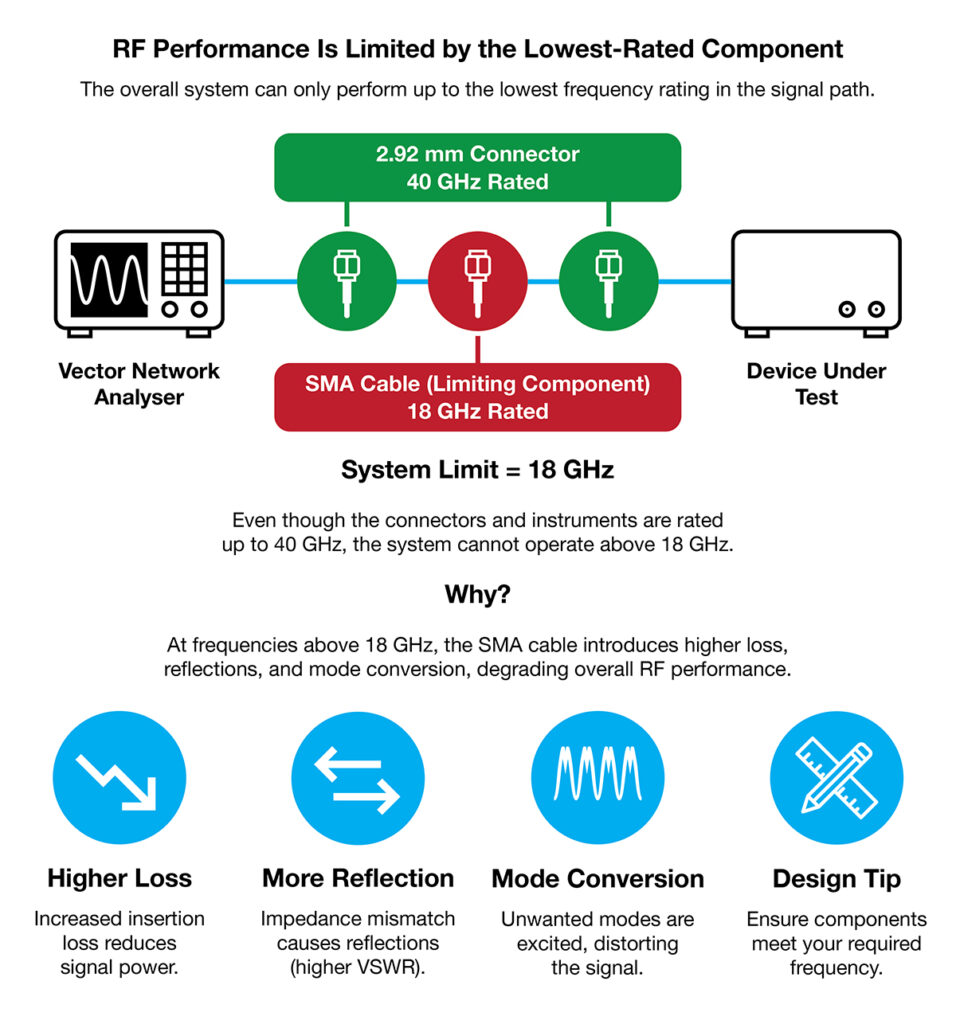
The overall RF performance is always limited by the lowest-rated component in the signal path. For example, a 40 GHz 2.92 mm connector connected to an 18 GHz SMA cable will only support an 18 GHz system, regardless of the connector’s individual capability.
Connector Selection Guide
The selection of an RF connector depends on the required frequency range, performance level, and application requirements. Standard SMA is the practical choice for most wireless and IoT applications due to its low cost, reliability, and availability. Precision SMA provides improved RF performance for applications requiring better accuracy and repeatability. For precision microwave measurements, 3.5 mm connectors offer higher performance and lower measurement uncertainty, while 2.92 mm connectors are designed for millimetre-wave applications requiring operation up to 40 GHz, such as 5G FR2, radar, and satellite systems. The connector should always be selected based on the complete RF system requirements.
Conclusion
Although SMA, Precision SMA, 3.5 mm, and 2.92 mm connectors look similar, they represent different levels of RF performance.
Their frequency capability depends on:
- Internal geometry
- Dielectric design
- Manufacturing accuracy
- Electromagnetic mode control
For most wireless and IoT products, standard SMA remains the practical choice. Precision SMA provides higher performance when improved RF accuracy is required. For microwave and millimetre-wave applications, 3.5 mm and 2.92 mm connectors provide the precision and frequency capability needed for advanced RF systems.
