
The way we use wireless connectivity is evolving rapidly, placing unprecedented demands on network infrastructure. With 5G data traffic expected to exceed 900 exabytes by 2027, increasing at around 62% per year, networks are being pushed to their limits.
Yet much of this demand is concentrated indoors, where traditional outdoor macro cell towers struggle to deliver consistent coverage and capacity due to signal attenuation, building materials, and increasingly dense user environments. As a result, a clear gap has emerged between where connectivity is needed most and how it is currently delivered.
As this gap becomes more pronounced, adoption is accelerating around a solution designed specifically for indoor coverage: <strong>Distributed Antenna Systems (often referred to as ‘DAS’).
The global DAS market, valued at approximately $10–12 billion in 2025, is projected to grow to over $37 billion by 2035, reflecting sustained investment driven by 5G rollouts, rising indoor data consumption, and the expansion of neutral host networks.
In this article, we explore how Distributed Antenna Systems (DAS) are transforming indoor wireless connectivity, the market momentum driven by 5G and IoT, and compare both active and passive DAS solutions, including antenna options and real-world deployment strategies across industries.
From Outdoor Macro to In-Building Coverage
<p>The challenge in meeting this increased demand for indoor connectivity lies in the limitations of RF signal propagation within buildings. Materials such as concrete, steel reinforcement, and energy-efficient glass significantly attenuate or reflect RF signals, weakening coverage as it moves indoors. As buildings become more energy-efficient and structurally dense, this effect is further amplified, making it increasingly difficult for outdoor cellular networks to provide reliable indoor service.
To overcome these limitations, signals must be delivered from within the building itself rather than relying solely on external towers. Distributed Antenna Systems achieve this by distributing cellular signals through a network of strategically placed antennas, ensuring consistent coverage even in large or architecturally complex environments.
rc=”https://www.siretta.com/wp-content/uploads/2026/04/DAS-Blog-Image-1-Marcom-1024×777.png” alt=”Infographic showing key difference between Distributed Antenna Systems and traditional outdoor macro coverage” width=”1024″ height=”777″ />
Market Momentum: The 5G Catalyst
Indoor wireless connectivity is no longer a secondary consideration; it is now recognised as critical infrastructure. With 70 to 80% of mobile data consumed indoors, particularly in dense urban environments, the limitations of traditional macro networks are driving sustained investment in in-building solutions such as DAS.
This shift is reflected in strong market growth. The global DAS market is currently valued at approximately $10.1 to $12 billion and is projected to reach $25 to $30 billion by 2030, representing a compound annual growth rate of around 10 to 13%. At the same time, the rise of private 5G networks is accelerating demand for in-building wireless infrastructure, while neutral host models allow multiple operators to share a single system, reducing both deployment complexity and cost.
As 5G networks continue to expand, particularly in mid-band frequencies such as 3.5 GHz, the need for reliable indoor coverage and capacity becomes more acute. These frequencies deliver higher bandwidth but are more susceptible to attenuation. In passive distribution systems, signal losses of around 15 dB per 100 metres of coaxial cable are not uncommon. This makes it increasingly difficult to maintain consistent performance across larger or more complex buildings. As a result, the method used to distribute signals within the building has become a critical design consideration.
Understanding DAS Architecture: Active vs. Passive Distributed Antenna Systems
DAS solutions are broadly classified as active or passive based on how signals are distributed throughout the building, rather than the antennas themselves.
Passive DAS uses coaxial cables, splitters, and combiners to distribute signal from a central source to multiple antenna points. While relatively simple and cost-effective to deploy, these systems are limited by cumulative signal loss. This limitation becomes more pronounced at higher frequencies, where attenuation increases and performance degrades over distance.
Active DAS addresses this by replacing long coaxial runs with fibre or structured cabling and deploying Remote Radio Units throughout the building. These units amplify and regenerate the signal, allowing consistent performance to be maintained regardless of distance. This approach also enables greater coverage and capacity, along with more advanced capabilities such as centralised management, real-time monitoring, and easier scaling as network demands grow.</p>
In practice, the antennas, such as Siretta’s Tango and Oscar series, act as the final interface between the network and user devices. They remain passive radiating elements whet
her used in passive systems or connected to active radio units. Their role is critical in shaping coverage quality and overall system performance. This flexibility allows the same antenna platforms to be used in both existing passive deployments and newer active DAS architectures, which are increasingly preferred for 5G environments due to their performance and scalability.
/>lass=”wp-image-170172″ src=””ht</yoastmark” />
Selecting the Right Antenna for Indoor DAS
Once the DAS architecture is defined, attention turns to how coverage is delivered within the space itself. In most indoor environments, this is achieved using ceiling-mounted omnidirectional antennas. These form the backbone of in-building wireless systems because they are best suited to delivering consistent, uniform coverage across open areas such as offices, retail floors, healthcare facilities, and public spaces.
By radiating signal evenly in all directions, ceiling-mounted antennas ensure that users experience stable connectivity regardless of their location or movement within the building. Their low-profile design also allows them to integrate cleanly into ceilings without disrupting the visual environment, which is particularly important in modern commercial interiors. In practice, they provide the baseline layer of coverage that most DAS deployments rely on.
A number of antenna platforms have been developed specifically for this role, combining wideband performance with discreet form factors and compatibility across both active and passive DAS systems.
Siretta’s Tango Series: Omnidirectional Coverage Perfected
Siretta’s Tango series represents antenna elements engineered specifically for modern DAS deployments and are compatible with both Passive and Active DAS architectures. These ceiling mount solutions excel in providing omnidirectional coverage across open spaces.
Tango 58 – Wideband Excellence
The Tango 58 offers broad frequency coverage spanning 600 to 8000 MHz, supporting 5G, 4G LTE, legacy cellular standards, and modern Wi-Fi technologies including Wi-Fi 6E and Wi-Fi 7. This wideband capability allows a single antenna to support multiple services while remaining adaptable to future network upgrades.

Key Features:
- Low-profile design, 115 mm protrusion from ceiling and 200 mm diameter
- Professional-grade N-Type female connectors
- Available in white or black housing
- Customisation options for connector types and cable length
- 1-2 dBi omnidirectional gain
Tango 59 – Multi-Carrier Performance
Building on this wideband approach, the Tango 59 extends frequency support further, operating across 400 to 8000 MHz. This makes it well suited to environments where a wide mix of services must be supported, including public safety systems alongside cellular and Wi-Fi technologies, while maintaining consistent coverage across indoor spaces.
Key Features:
- Ultra-low-profile design: 11 mm protrusion from ceiling
- SiSo configuration (single port)
- 2–3 dBi omnidirectional gain for consistent indoor coverage
- Plenum cable supporting low passive intermodulation for clean signal performance
- WLAN compatible (IEEE 802.11 a/b/g/n)
Tango 60 – Discreet High-Capacity Coverage
The Tango 60 combines a ceiling-mounted form factor with 4×4 MIMO capability, supporting modern 4G and 5G indoor coverage requirements. Its clean design makes it particularly well suited to environments where aesthetics are important, such as corporate offices, hospitality venues, and healthcare settings.
Key Features:
- 4×4 MIMO capability with four independent ports
- Wideband coverage: 600–6000 MHz
- Ultra-low profile design (23 mm height)
- Average gain of 5 dBi with peak performance up to 7.47 dBi
Tango 61 – Efficient 2×2 MIMO Coverage
The Tango 61 supports 2×2 MIMO, one of the most widely adopted configurations for indoor wireless networks, offering a strong balance between performance and deployment efficiency. Operating across 690 to 6000 MHz, it supports modern 4G, 5G, and Wi-Fi services while providing consistent coverage across a wide range of indoor environments.
Key Features:
- Two cables with N-Type female connectors
- Omnidirectional radiation pattern for uniform coverage
- Low-profile design for discreet ceiling integration
- Balanced performance for medium-density deployments
- Suitable for cost-effective MIMO upgrades
For the majority of indoor Distributed Antenna Systems deployments, this ceiling-mounted omni layer will provide the coverage required across most of the building. It is typically the primary design consideration and, in many cases, sufficient on its own.
There are, however, situations where omnidirectional coverage alone cannot fully address the environment. Long corridors, lift shafts, stairwells, perimeter zones, and certain semi-outdoor or high-density areas may require more focused RF control or additional reach.
In these cases, directional panel antennas can be introduced to complement the main coverage layer.
Oscar 64 – C-Band 5G Specialist
The Oscar 64 is designed for 5G mid-band deployments, specifically targeting the 3.3 to 4.7 GHz spectrum where capacity demand is highest. Its directional pattern allows signal to be focused into specific areas, improving performance and reducing interference in high-density environments.
Key Features:
- Optimised for 5G C-band (3300–4700 MHz)
- 4×4 MIMO support via four N-Female connectors
- ±45° slant polarisation for improved signal stability
- Directional radiation pattern for targeted coverage
- Rugged enclosure also suitable for indoor and outdoor use
Oscar 65 – Ultimate Versatility
The Oscar 65 provides extremely broad frequency coverage, spanning 600 to 8000 MHz. This makes it well suited to neutral host and multi-operator environments where multiple services must be supported through a single antenna infrastructure.
Key Features:
- Ultra-wideband coverage: 600–8000 MHz
- 4×4 MIMO capability for enhanced throughput
- Suitable for multi-operator and shared network deployments
- Directional pattern for controlled RF distribution
- Designed for both indoor and semi-outdoor applications
Oscar 66 – Legacy and IoT Integration
The Oscar 66 supports a wide range of cellular technologies, from legacy 2G and 3G through to modern 4G LTE and 5G, along with LTE-M and NB-IoT for low-power IoT applications. This makes it particularly useful in environments where a mix of technologies must coexist.
Key Features:
- Up to 7.5 dBi gain for extended reach
- Wide beamwidth for effective area coverage
- High port isolation (12–28 dB) for efficient 2×2 MIMO
- Stable directional pattern for controlled coverage
- Supports combined cellular and Wi-Fi environments
In practice, effective Distributed Antenna Systems design is rarely about choosing one antenna type over another. Ceiling-mounted omnidirectional antennas provide the primary coverage layer across the building, while directional panels are added selectively to address specific challenges. This layered approach ensures consistent performance throughout the space while allowing the network to adapt to more complex environments where additional control is needed.
Real-World Impact Across Industries
Commercial Offices – Lead DAS adoption driven by employee connectivity expectations. Modern offices generate enormous traffic from video conferences, cloud applications, and collaboration tools. DAS ensures robust connectivity in interior conference rooms, basements, and core areas.
Healthcare Facilities – Require DAS for telemedicine, mobile EHR access, patient monitoring, and staff communications. Complex architecture with concrete, steel, and X-ray shielding necessitates carefully engineered solutions for complete patient care area coverage.
Transport Infrastructure – Airports, railway stations, and underground systems combine massive user density with RF-hostile environments. Multi-operator neutral host architectures have become standard, enabling all carriers to share infrastructure.
Stadiums and Arenas – Face the ultimate stress test with tens of thousands of simultaneous users. Sophisticated DAS architectures with extensive antenna arrays and smart monitoring manage dramatic traffic swings between events.
Industrial Facilities – Rapidly adopt DAS for Industry 4.0, robotics, automated vehicles and real-time monitoring. Private 5G networks over DAS provide ultra-reliable low-latency connectivity for automation, with manufacturers achieving significant operational improvements.
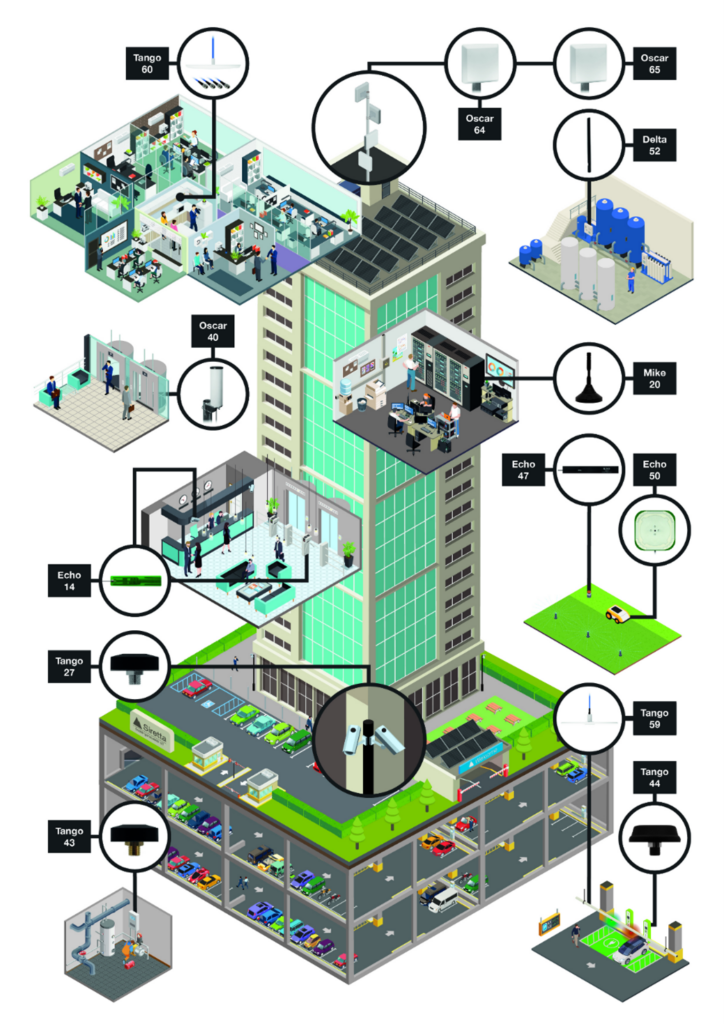
Smart Building infographic illustrating the role of Siretta RF antennas in delivering end-to-end connectivity across DAS, building systems, security, and smart automation.
The Road Ahead
As demand for indoor connectivity continues to grow, the role of Distributed Antenna Systems is becoming increasingly central to modern network design. Higher frequency 5G spectrum, particularly in mid-band and mmWave, brings significant capacity gains but also introduces greater propagation challenges. This makes reliable in-building coverage not just desirable, but essential.
At the same time, expectations of what indoor networks must support are evolving. Beyond basic connectivity, organisations now rely on wireless infrastructure to enable smart building systems, real-time monitoring, automation, and data-driven decision making. From energy management and security to workplace optimisation and industrial operations, these applications depend on consistent, high-quality coverage throughout the environment.
This shift is changing how indoor connectivity is viewed. It is no longer treated as an extension of the outdoor network, but as a core part of the digital infrastructure that underpins building performance and user experience.
In this context, antenna selection remains a critical part of the overall system design. Ceiling-mounted omnidirectional antennas provide the foundation for consistent indoor coverage, while directional panels are used selectively to address more complex or high-demand areas. Together, they enable flexible, scalable deployments that can adapt to the specific requirements of each environment.
Siretta’s portfolio of Tango ceiling-mounted and Oscar panel antennas supports this approach, offering a range of solutions designed to meet the demands of modern indoor wireless networks. By combining wideband performance, flexible deployment options, and support for both cellular and wireless technologies, these antennas provide the building blocks for reliable, future-ready connectivity.
Ultimately, organisations that invest in robust indoor wireless infrastructure are better positioned to support productivity, efficiency, and innovation. As the volume of connected devices continues to grow and applications become more data-intensive, the importance of getting indoor connectivity right will only increase.
About Siretta
At Siretta, we understand the challenges involved in delivering reliable wireless connectivity and have developed our own antenna selector tool to help reduce time to market. Our portfolio includes cellular modems and terminals, routers, cellular network analysers, and a wide range of RF antennas, including MIMO solutions, as well as products supporting WLAN, LoRa, and Sigfox applications.
We also offer RF cable assemblies and accessories, with solutions typically covering frequencies from 400 MHz to 8 GHz, spanning HF, VHF, ISM, cellular, and GNSS bands.
If you have a project related to Distributed Antenna Systems that you need support with, or would like to discuss the best antenna solution for your deployment, get in touch with our sales team.