
GPS accuracy is typically poor near buildings because the receiver is no longer receiving a clean, direct signal from the satellites. Instead, signals are either partially blocked or reflected off surrounding structures such as glass, steel and concrete. These reflected signals travel a longer path and arrive later than the direct signal, introducing timing errors. Since GNSS positioning depends on very precise timing, even small delays can result in position errors of several metres.
In dense urban environments, often referred to as urban canyons, this effect becomes more pronounced. The receiver may only see a limited number of satellites, and some of those may be reflections rather than true line-of-sight signals. Although modern receivers attempt to mitigate this in software, they cannot fully correct poor signal conditions at the antenna.
In practice, this shows up as position drift, slow fix times, or large jumps in reported location, particularly when moving between open areas and built-up streets.
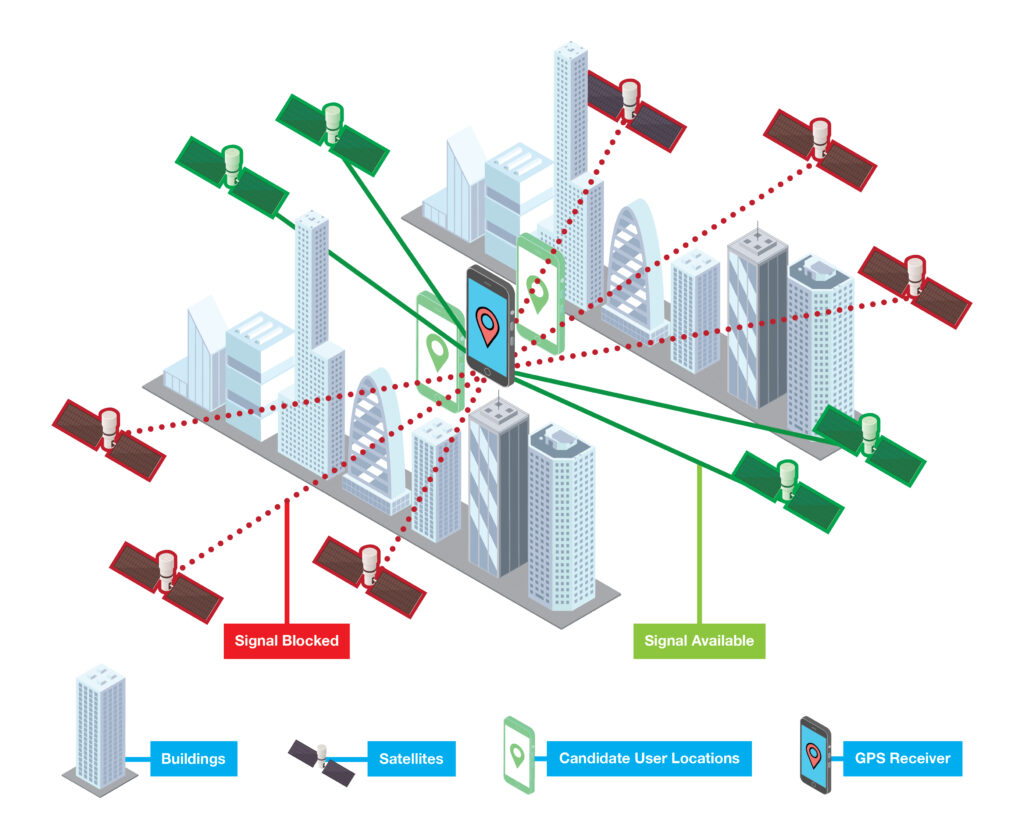
Direct and reflected GNSS signals in urban environments. Buildings block line-of-sight signals and create delayed reflections, leading to positioning errors.
How to improve GPS accuracy in urban environments
1: Antenna placement
The antenna location has the biggest impact on performance.
It should be positioned as high as possible with a clear view of the sky. Mounting low down, inside an enclosure, or close to vertical metal surfaces will increase reflections and reduce direct signal reception. In vehicle applications, a roof-mounted antenna will consistently outperform one placed on a dashboard or inside the cabin.
Keeping distance from nearby metal surfaces is also important. Vertical conductive surfaces act as reflectors and can significantly increase multipath errors if the antenna is mounted too close to them.
2: Antenna type
For static installations, a patch antenna with a suitable ground plane is generally preferred. The ground plane helps maintain a stable radiation pattern and reduces sensitivity to low-angle reflected signals.
For mobile applications, external active antennas are typically used. Antennas such as the Mike 19 provide a practical balance of gain and radiation performance for vehicle or asset tracking, particularly when mounted with a clear view of the sky.
In embedded designs where the antenna must be located inside the product, ground plane size and placement become limiting factors. In these cases, compact active antennas such as the Echo 52 are designed to operate with reduced ground planes while maintaining acceptable polarisation and performance.
3: Antenna gain and noise
GNSS signals are very weak when they reach the earth, so an active antenna with a low-noise amplifier is typically required.
Lower noise figure improves signal quality, but gain must be considered in the context of the full system. Too little gain will result in poor tracking, while excessive gain can raise the noise floor or make the system more susceptible to interference from nearby radios.
4: Cabling
Cable losses can significantly affect performance, particularly at GNSS frequencies.
Where possible, the cable between the antenna and receiver should be kept short. If a longer cable is required, a low-loss coaxial cable should be used and the antenna gain selected to compensate for the additional attenuation.
5: GNSS receiver capability
Using a receiver that supports multiple constellations such as GPS, GLONASS and Galileo can improve performance in urban environments by increasing the number of available satellites and improving positioning geometry.
Multi-frequency operation can also help reduce certain error sources, although it does not eliminate multipath caused by reflections from nearby buildings.
Summary
Poor GPS accuracy near buildings is usually caused by a combination of signal blockage and multipath reflections, rather than an issue with the receiver itself. The most effective improvements come from optimising antenna placement, ensuring a clear view of the sky, and selecting an antenna suited to the installation.