
When comparing active vs passive GPS antennas, the key difference is where signal gain is introduced in the RF signal chain.
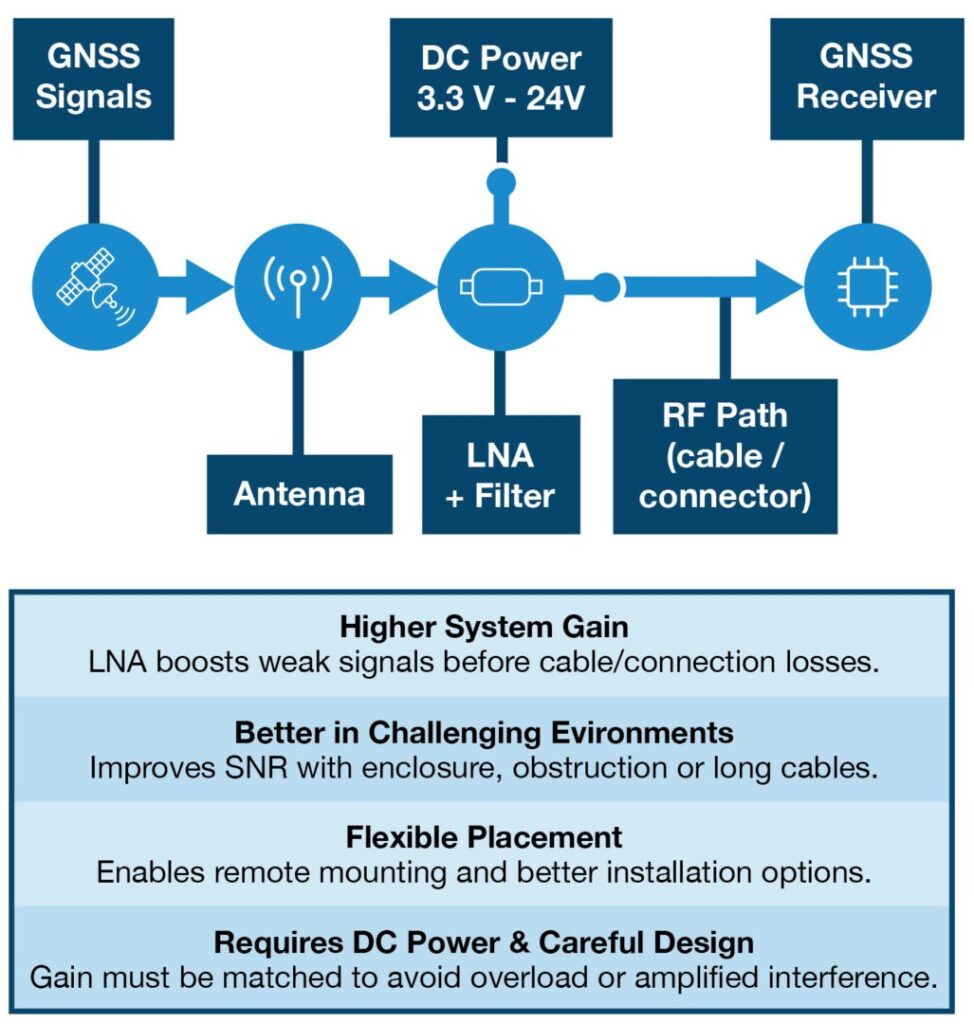
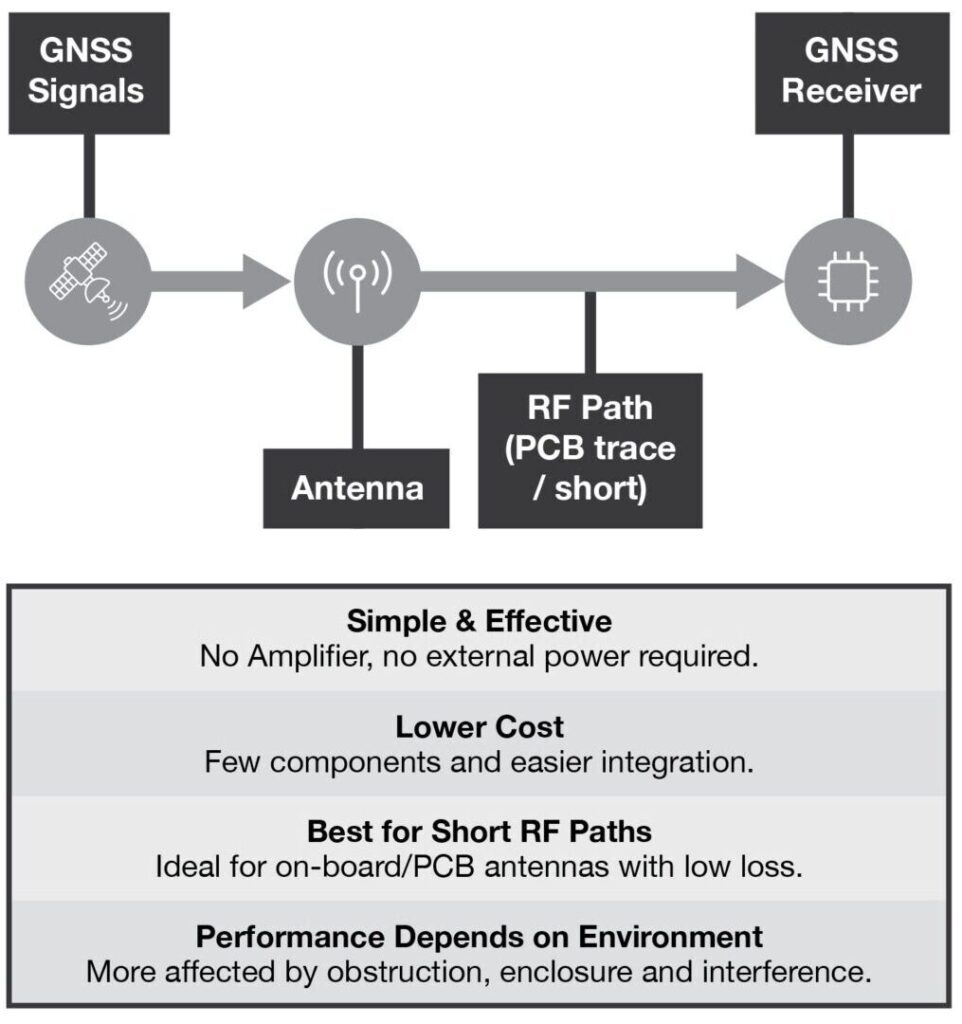
A passive GPS antenna consists only of the antenna element. It receives GNSS signals and passes them directly to the receiver with no amplification. In contrast, an active GPS antenna integrates a low-noise amplifier (LNA) directly after the antenna element. This boosts the signal before it reaches the receiver.
This distinction is important because GNSS signals arrive at the Earth at extremely low power levels. Any loss in the system (whether from PCB traces, connectors, or cables) can reduce signal quality and impact positioning performance.

Active antennas: benefits and trade-offs
Active GPS antennas typically provide around 15–30 dB of LNA gain, along with filtering to reduce out-of-band interference.
They are commonly used when:
- The antenna is remotely mounted
- The signal path includes connectors or coaxial cable
- The installation environment reduces signal strength
However, more gain is not always better. Excessive amplification can:
- Overload the receiver front-end
- Amplify interference from nearby RF sources (e.g. LTE, 5G)
- Reduce overall system dynamic range
For best performance, antenna gain should be matched to the total system loss.
Passive antennas: where they make sense
Passive GPS antennas are typically used in:
- Compact embedded designs
- PCB-mounted ceramic patch antennas
- Applications with minimal RF path loss
They offer:
- Lower cost
- No power requirement
- Simpler integration
But they rely entirely on good placement, grounding, and system design to perform well.
What changes in real installations?
In practice, the difference between active vs passive GPS antennas is not just about gain; it’s about how well the system handles real-world losses.
A passive antenna works well when:
- The antenna is placed directly on the PCB
- The RF path to the receiver is very short
- There is a clear view of the sky
However, performance can degrade quickly if:
- The antenna is inside an enclosure
- The ground plane is limited
- The environment introduces attenuation or interference
An active antenna helps compensate for these losses by amplifying the signal early in the signal chain. This improves the signal-to-noise ratio (SNR) at the receiver input and helps maintain reliable satellite tracking.
Power and integration considerations
Active antennas require a DC supply, usually delivered via the RF cable (bias tee).
- Typical operating voltage: 3.3 V to 24 V
- Without power, the LNA becomes a loss element
- Performance may drop below that of a passive antenna
This is a common integration issue in GNSS designs.
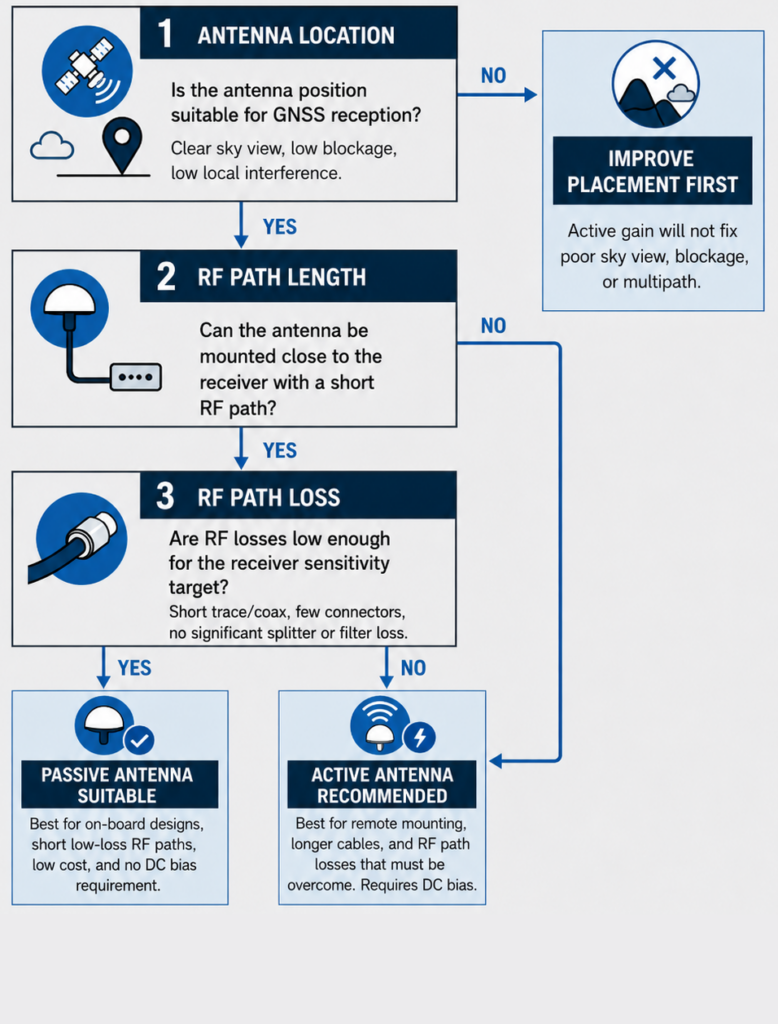
Selection flow chart for choosing between active and passive GNSS antennas
Practical summary
The choice between active vs passive GPS antennas is not simply about antenna type, it’s about overall system performance.
- Use a passive antenna when the RF path is short and losses are minimal
- Use an active antenna when system losses or environmental factors reduce signal strength
In most embedded designs, passive antennas are sufficient. But in real-world installations (especially where placement or environment is less controlled) active antennas provide the margin needed for reliable GNSS performance.
Explore Siretta’s range of GNSS antennas or speak to our engineering team for guidance on selecting the right active or passive solution for your design!
