
When assessing cellular coverage, many people look at the signal bars displayed on a smartphone, router or modem. More bars are often assumed to mean better performance, while fewer bars suggest weaker coverage.
In reality, signal bars only provide a very limited view of what is happening on a cellular network.
It is entirely possible to have four or five bars of signal and still experience slow data speeds, intermittent connectivity or unreliable communications. This is because signal strength is only one part of the equation. To understand how a cellular connection is likely to perform, signal quality must also be considered.
For industrial IoT deployments, remote monitoring systems, telemetry applications and critical infrastructure, understanding the difference can help avoid costly installation issues and improve long-term reliability.
Signal Strength and Signal Quality Are Not the Same Thing
Signal strength refers to how strongly a device receives a signal from a cellular base station. In LTE and 5G networks, this is commonly measured using RSRP (Reference Signal Received Power).
Signal quality measures how effectively that signal of a connection.
As a result, two locations with similar signal strength readings can deliver very different real-world performance.
Why Strong Signal Strength Can Still Deliver Poor Results
There are several factors that can affect performance even when signal strength appears good.
Network Congestion
Cellular networks are shared by many users and devices. As more users connect to a cell, the available network resources must be shared.
This means a location may show excellent signal strength while still experiencing reduced throughput during busy periods.
Radio Frequency Interference
Signals from neighbouring cells, reflections from buildings and other sources of radio frequency interference can affect communication quality.
Although a device may still detect a strong signal, interference can make it more difficult to reliably receive and decode data.
Installation Environment
Many industrial devices are installed inside control cabinets, electrical enclosures, plant rooms or utility compounds.
Materials such as metal, reinforced concrete and specialist glazing can impact radio performance. In some cases, a device may report acceptable signal strength while still suffering from poor signal quality.
Cell Selection
A modem or router will not always connect to the most suitable cell available.
Depending on network conditions, a device may attach to a cell that provides strong coverage but offers lower capacity or higher levels of congestion than neighbouring cells.
Looking Beyond Signal Bars
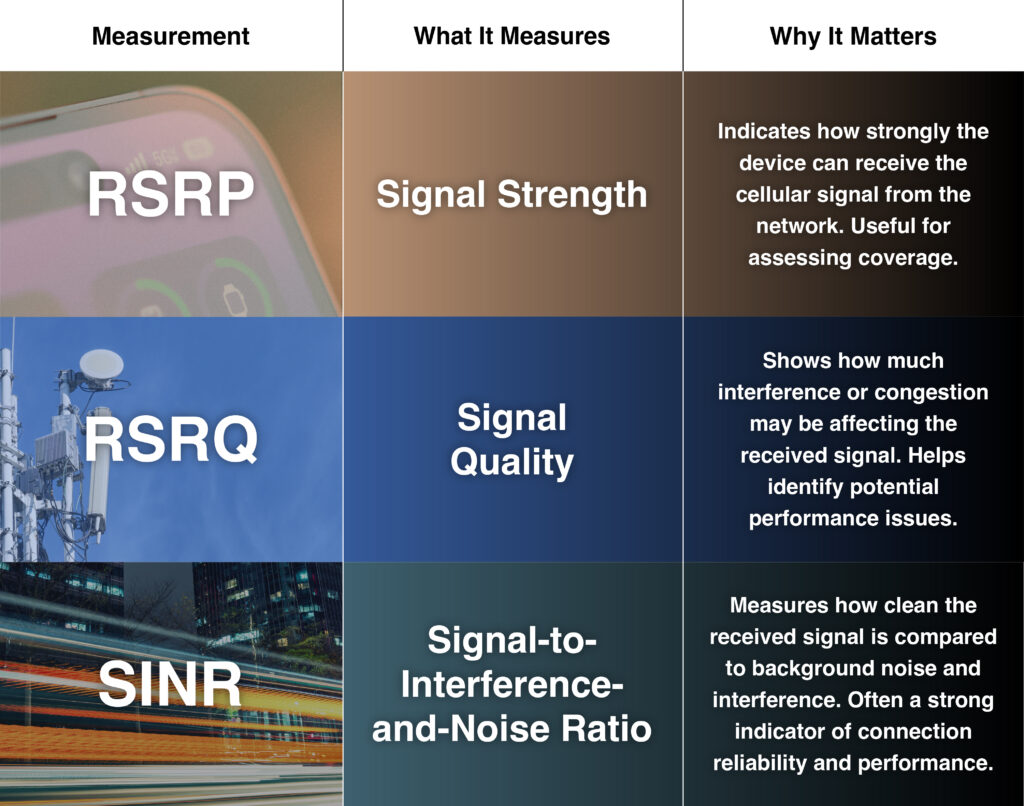
Professional cellular surveys typically focus on measurements that provide a more detailed understanding of network conditions.
RSRP – Signal Strength
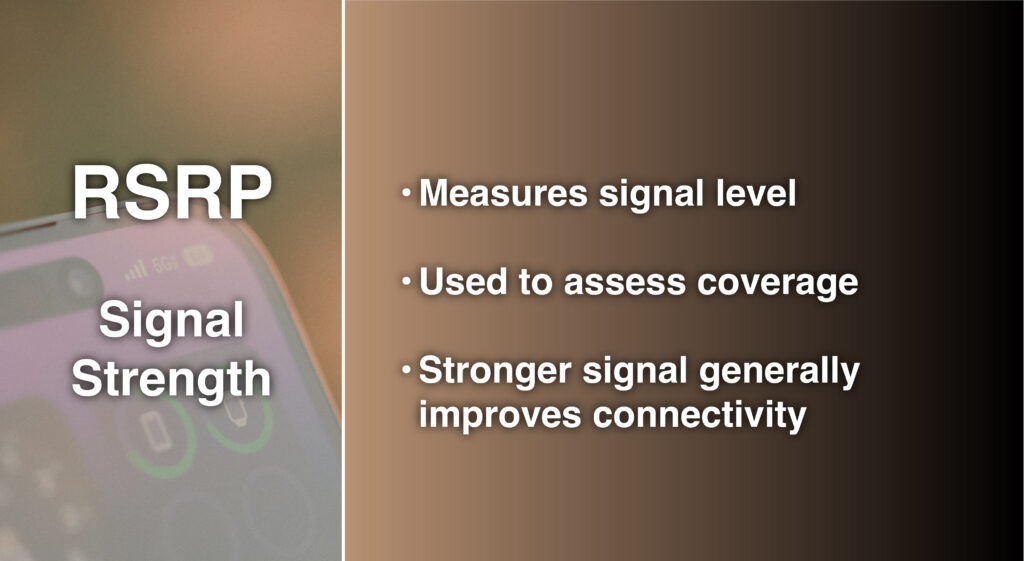
RSRP (Reference Signal Received Power) is a measure of received signal strength.
It helps determine how well a device can deect a cellular signal and is commonly used to assess network coverage. Values closer to zero generally indicate stronger coverage, whilst lower values indicate weaker signal conditions.
RSRQ – Signal Quality
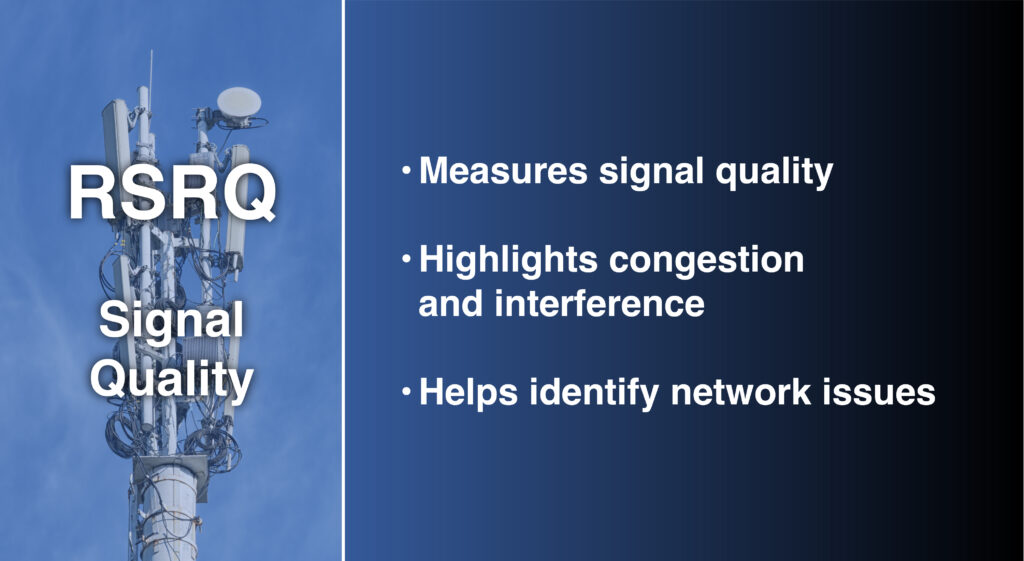
RSRQ (Reference Signal Received Quality) provides an indication of overall signal quality.
It can help identify issues caused by network congestion, interference and other factors that may affect performance.
A location may have good RSRP readings but poor RSRQ values, indicating that signal quality could become a limiting factor.
SINR – Signal-to-Interference-and-Noise Ratio
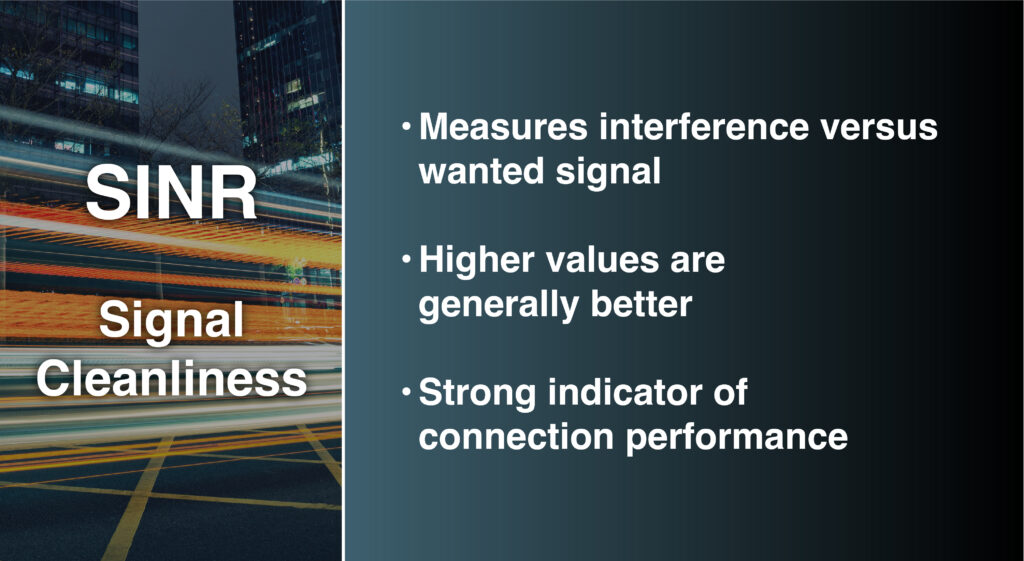
SINR measures the relationship between the wanted signal and any unwanted interference or background noise.
It is often one of the most useful indicators when assessing the potential performance and reliability of a cellular connection.
Higher SINR values generally indicate a cleaner radio environment and can contribute to improved data performance and connection stability.
A Practical Example
Consider a remote telemetry installation where two network operators both provide LTE coverage at the same location.
A basic check using a smartphone may show similar signal bars for both operators, suggesting that either network would be suitable.
However, a detailed survey may reveal that whilst both operators provide comparable signal strength, one network delivers significantly better SINR values and lower levels of interference.
Although the difference is not visible through signal bars alone, the higher-quality network is likely to provide more reliable long-term performance and fewer communication issues once the device is deployed.
Why Signal Quality Matters for IoT Deployments
For many IoT applications, reliability is more important than maximum data speed.
Smart meters, environmental monitoring systems, industrial controllers, utility infrastructure and remote monitoring equipment often transmit relatively small amounts of data, but they need to do so consistently and dependably.
Poor signal quality can result in:
- Increased transmission retries
- Reduced battery life
- Higher power consumption
- Delayed data delivery
- Intermittent connectivity
- Increased support and maintenance costs
These issues can remain hidden during installation and only become apparent once a deployment is operational.
The Value of a Cellular Site Survey
A professional cellular survey provides far more insight than signal bars alone.
By measuring signal strength, signal quality, available technologies and operator availability, engineers can make informed decisions before equipment is installed.
The same principles apply whether assessing LTE, LTE-M, NB-IoT or 5G networks.
A survey can help organisations:
- Select the most suitable network operator
- Identify the best antenna location
- Confirm network availability
- Reduce installation risk
- Minimise engineer revisits
- Improve long-term reliability
For larger deployments, these benefits can translate into significant operational and cost savings.
Looking Beyond the Signal Bars
Signal bars provide a useful indication of coverage, but they rarely tell the full story.
A strong signal does not automatically guarantee reliable performance, and a location that appears suitable at first glance may present challenges once equipment is deployed.
By understanding measurements such as RSRP, RSRQ and SINR, engineers can gain a much clearer picture of real-world network conditions and make better decisions when selecting operators, positioning antennas and planning deployments.
Whether deploying a single IoT device or managing a nationwide rollout, assessing signal quality alongside signal strength can help deliver more reliable connectivity and better long-term outcomes.
A strong signal (RSRP) does not always guarantee good performance. Signal quality (RSRQ) and signal cleanliness (SINR) often provide a more complete picture of real-world network conditions.
